From $4K to $25K a Month: How Strategic SEO Met CRO to 6.25× a Small Brand's Organic Revenue
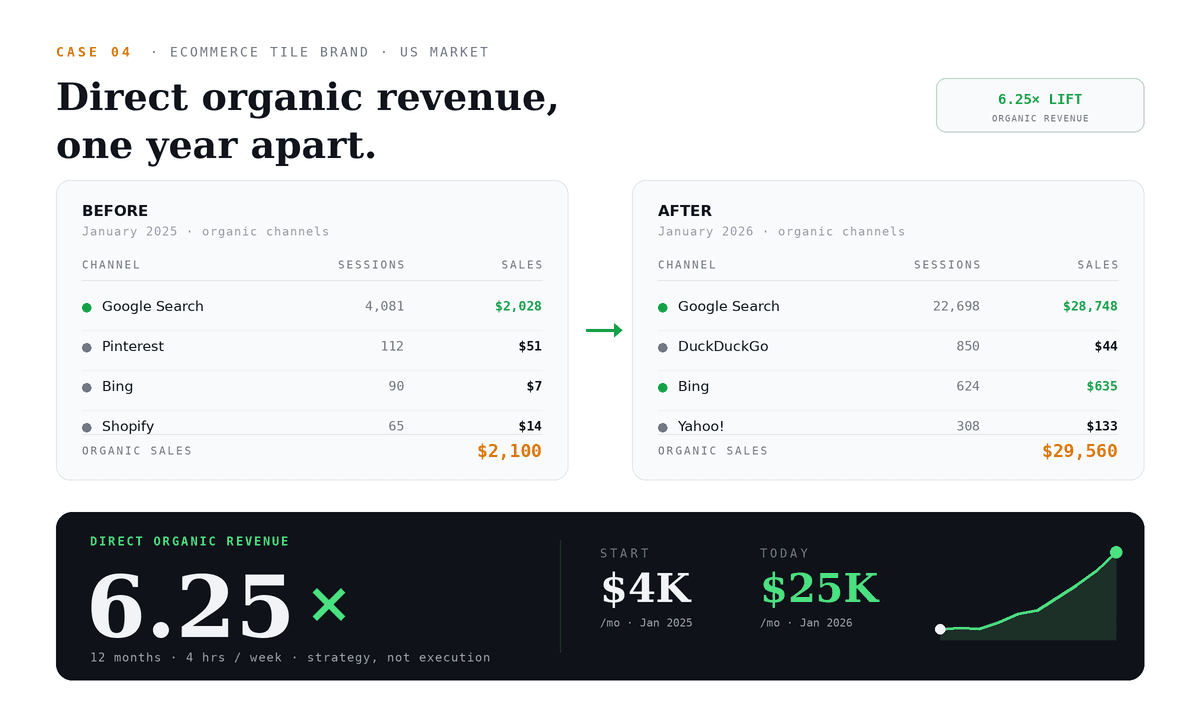
A small US e-commerce tile brand came to me doing $4,000/month in direct organic revenue. They were competing in a category dominated by giants — Home Depot and Lowe's — brands with roughly 100× the budget. On paper, that's an unwinnable fight. In practice, it's exactly the kind of fight a smaller brand can win, provided it stops trying to out-spend and starts trying to out-think.
The Challenge
Early in 2025, the communication site was failing to attract search traffic and reach people wanting alternatives to text messaging and chat.
Only a few landing pages geared toward generic terms
Very limited indexing and almost no keyword reach
No scalable content model for different communication modalities
Content creation could not keep pace with the breadth of user intents
The Action Plan
I ran the account on two levers, pulled together and measured against a single number — direct organic revenue.
Solution 1
Rebuilt the SEO strategy around purchase intent, targeting buyers actively looking to buy tile rather than traffic that padded a dashboard and left.
Solution 2
Optimized the moment after the click — product pages, trust signals, and the path to purchase — so qualified traffic converted instead of bouncing.
Solution 3
A/B tested relentlessly: headlines, product-page layouts, CTAs, and trust signals. With finite traffic, every change had to earn its place on evidence, not opinion.
Solution 4
Anchored every decision to direct organic revenue — not sessions, not rankings, not brand-lift index — so tactics resolved themselves against the metric that pays the bills.
The Results
Clicks
Organic Revenue
Key Takeaways
The biggest unlock wasn't a tactic — it was a mindset: SEO brings the right people to the page. CRO decides whether they leave with a cart or a bounce. Optimize one without the other and you're just paying to fill a leaking bucket. The 6.25X lift didn't come from more traffic alone, or better conversion alone. It came from the interplay between them, compounded consistently on four hours a week of strategy. For a small brand, that's the whole game — out-learn the giants faster than they can react, instead of trying to out-spend them.
Treating SEO and CRO as one connected motion, not two silos
A/B testing every meaningful change instead of guessing
Measuring add to carts and thus revenue as a primary metric alongside sessions or rankings